Sign in to your account
or
By signing in you agree to our
Terms & conditions
 and 
Privacy policy

AD 10mg Sachet

Written By Dr. Betina Chandolia, MDS, BDS
Reviewed By Dr. Lalit Kanodia, MBA, MD Pharmacology
Last updated on 12 Nov 2024 | 01:02 AM (IST)
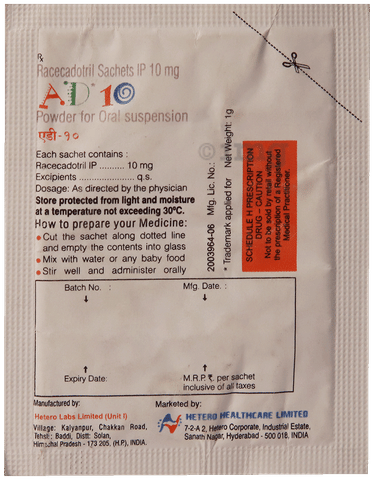
AD 10mg Sachet is a commonly prescribed medicine for the symptomatic treatment of acute diarrhea in infants and children. This medicine is usually given when diarrhea cannot be treated effectively with fluids and dietary measures. It reduces the amount of water and salts that are lost in the stools.
Genuine
Authenticity Assured
Prescription
required
₹11.6 MRP ₹123% off 
Sku unavailable
 
 
0
footer-icon
efsr frrrrrr
aaa

General Information

The content is shown in English

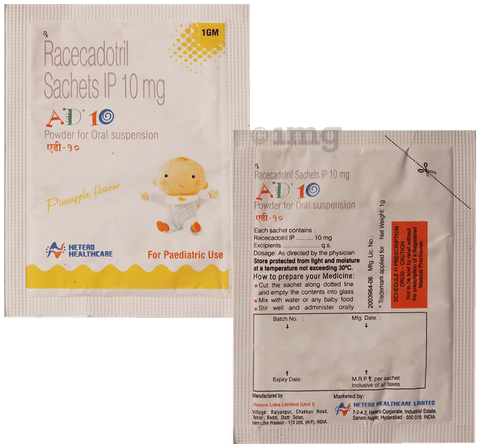
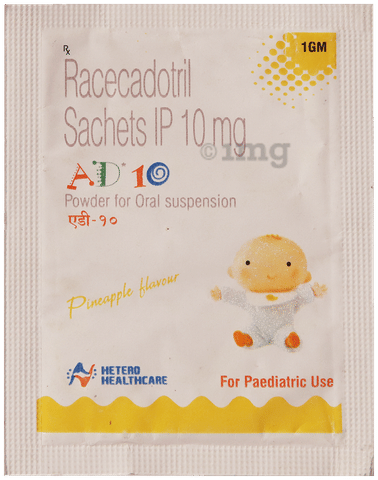
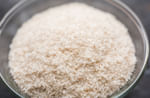
AD 10mg Sachet image

Your child’s medicine at a glance

Give AD 10mg Sachet to your child orally either before or after food, preferably in addition to ORS (oral rehydration solution). Usually, it is given three times a day, but this dose will vary depending upon the child's body weight and age. If your child vomits within 30 minutes of taking AD 10mg Sachet, repeat the same dose once your child feels better. Along with taking this medicine, your child needs to drink plenty of fluids and eat a healthy balanced diet.

This medicine may cause some minor and short-term side effects such as headache, skin rash, fever, respiratory disorder, and constipation. These episodes are temporary and subside on their own once the child’s body adapts to the medicine. However, in case they persist for long or start bothering your child, you must consult your child’s doctor without any delay.

Your child’s doctor must be aware if your child has ever had any previous episode of allergy, bowel obstruction, electrolyte imbalance, liver impairment, and kidney malfunction. This will guide the doctor in planning your child’s overall treatment.

Uses of AD 10mg Sachet in children

Side effects of AD 10mg Sachet in children

AD 10mg Sachet does not pose serious side effects and is well-tolerated by children. In case the side effects do occur, they’re likely to subside once the body adapts to the medicine. Consult your child’s doctor if these side effects persist or bother your child. The most common side effects include-
Common side effects of AD
  • Skin rash
  • Vomiting
  • Headache
  • Fever
  • Respiratory disorder

How can I give AD 10mg Sachet to my child?

Take this medicine in the dose and duration as advised by your doctor. Check the label for directions before use. Empty the granules in a glass of water/milk, stir it and consume immediately. AD 10mg Sachet is to be taken with food.

How AD Sachet works

AD 10mg Sachet has an anti-secretory effect. It reduces the secretion of water and electrolytes from the intestine. This helps to replenish the amount of fluids lost from the body in diarrhea.

Quick tips

  • AD 10mg Sachet should be used together with an oral rehydration solution (ORS) to provide adequate fluid and electrolyte replacement.
  • Give your child plenty of fluids to replenish water and mineral loss.
  • Do not use AD 10mg Sachet, if your child has blood and pus in the stools or fever. This may be due to bacterial infection and may need different treatment.
  • AD 10mg Sachet is not recommended to be taken more than 7 days unless advised otherwise.
  • Do not mix AD 10mg Sachet along with any other herbal or ayurvedic medicine as it can harm.
  • Do not give AD 10mg Sachet if your child has persistent uncontrolled vomiting as this medicine will not be absorbed.
  • Do not give AD 10mg Sachet if your child is less than 3 months of age.

Safety advice

Kidney

Kidney

CAUTION
AD 10mg Sachet should be used with caution in patients with kidney disease. Dose adjustment of AD 10mg Sachet may be needed. Please consult your doctor.

Liver

Liver

CAUTION
AD 10mg Sachet should be used with caution in patients with liver disease. Dose adjustment of AD 10mg Sachet may be needed. Please consult your doctor.

sljrsr jrjrrrrr

Frequently asked questions

Treatment with AD 10mg Sachet should be continued until two normal stools are passed. However, if the diarrhea does not get better after seven days of treatment you must talk to the doctor. Make sure neither to extend nor to stop the treatment by yourself without consulting your child’s doctor. Doing so may have side effects or may lead to a recurrence of symptoms.
Usually, AD 10mg Sachet does not enter into the central nervous system and lacks the potential to cause serious side effects such as neurotoxicity. But, since children below the age of 2 have underdeveloped membranes, there could be a chance of the medicine entering the brain and causing side effects. So, consult your child’s doctor before giving AD 10mg Sachet in such a condition.
No, children having intolerance to dairy products and milk are advised not to take this medicine as it contains lactose.
No, do not give AD 10mg Sachet if your child is passing stools mixed with blood or pus along with having a high body temperature (fever). These symptoms are indicative of some underlying pathology (infection) and may require some other line of treatment.
The use of AD 10mg Sachet in chronic diarrhea has not been sufficiently studied. Therefore, it is best to consult your child’s doctor before giving this medicine to your child for long-term diarrhea.
Although AD 10mg Sachet is not known to cause any interaction with other medicines, you should inform the doctor if your child is taking any medicine. It is best to narrate the complete medical history of your child as this will help the doctor understand your child’s needs better.

Fact Box

Chemical Class

N-Acyl-Alpha Amino Acids Derivatives

Habit Forming

No

Therapeutic Class

GASTRO INTESTINAL

Action Class

Enkephalinase Inhibitors

Related lab tests

test
Related ayurvedic ingredients
100% genuine products
Safe & secure payments

No contact delivery

No contact delivery
Fully sanitized facilities

User feedback

Once A Day
75%
Twice A Day
25%
Diarrhoea
100%
Poor
83%
Average
17%
Vomiting
50%
Fever
50%
With or without food
100%
Not Expensive
67%
Average
33%

Patient concerns

Sugar after breakfast is 250 ad

Dr. Sanjay Bhatt
Dr. Sanjay Bhatt
Physician
Increased level. Discuss with your doctor as some dose adjustment required if you are not having any diet failure.

Dear Doctor i feel constipation while passing the stool in the morning i even feel pain after the motion the pain occur after 1 to 2 hours of motion. I even have to visit the toilet 2 to 3 times to clear the stomach .Please help me in this regard.

Dr. Rekha Pohani
Dr. Rekha Pohani
Dietetics/Nutrition
Have salads ad fruit

<h3 class=titleMediumExtraBold>Want to know more</h3>

Want to know more

We provide you with authentic, trustworthy and relevant information

<h3 class=titleMediumExtraBold>Have issue with the content</h3>

Have issue with the content

Disclaimer

Tata 1mg's sole intention is to ensure that its consumers get information that is expert-reviewed, accurate and trustworthy. However, the information contained herein should NOT be used as a substitute for the advice of a qualified physician. The information provided here is for informational purposes only. This may not cover everything about particular health conditions, lab tests, medicines, all possible side effects, drug interactions, warnings, alerts, etc. Please consult your doctor and discuss all your queries related to any disease or medicine. We intend to support, not replace, the doctor-patient relationship.

Marketer details

Name: Hetero Drugs Ltd
Address: 7-2-A2, Hetero Corporate, Industrial Estates, Sanath Nagar, Hyderabad – 500 018. Telangana, INDIA

Vendor Details

Country of origin: India
Why we need a prescription?
Image of Step
Provide right medicines
Prescriptions are complex documents. We proof read and recheck at various steps to provide you the right medication in the correct form and dose

Image of Step
In accordance with the law
Most medicines cannot be sold without a valid prescription, as per the Drugs and Cosmetics Act, 1940 and Rules, 1945
close sheet