







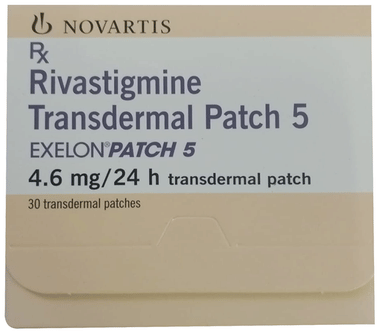
Exelon Transdermal Patch 5
Rivastigmine (4.6mg)
 Genuine
Authenticity Assured
 Prescription
required
Exelon Transdermal Patch 5 helps treat mild to moderate dementia in Alzheimer’s disease, a progressive (worsening) illness that gradually affects memory and thinking. It is also used to treat Dementia in Parkinson’s disease. It does not cure these illnesses but may help improve memory, awareness, and other symptoms.
Written By Dr. Swati Mishra, BDS,
Reviewed By Dr. Khushbu Goel, DM, MD,
Last updated on 11 Nov 2024 | 01:09 AM (IST)
Written By Dr. Swati Mishra, BDS,
Reviewed By Dr. Khushbu Goel, DM, MD,
Last updated on 11 Nov 2024 | 01:09 AM (IST)
Available pack size
General Information

The content is shown in English




Safety advice

Alcohol
No interaction found/established

Pregnancy
CONSULT YOUR DOCTOR
Exelon Transdermal Patch 5 is unsafe to use during pregnancy as there is definite evidence of risk to the developing baby. However, the doctor may rarely prescribe it in some life-threatening situations if the benefits are more than the potential risks. Please consult your doctor.

Breast feeding
CONSULT YOUR DOCTOR
Exelon Transdermal Patch 5 is probably unsafe to use during breastfeeding. Limited human data suggests that the drug may pass into the breastmilk and harm the baby.

Driving
No interaction found/established
Kidney
SAFE IF PRESCRIBED
Exelon Transdermal Patch 5 is safe to use in patients with kidney disease. No dose adjustment of Exelon Transdermal Patch 5 is recommended.
However, inform your doctor if you have an underlying kidney disease as close monitoring is advised while you are taking this medicine.
However, inform your doctor if you have an underlying kidney disease as close monitoring is advised while you are taking this medicine.

Liver
SAFE IF PRESCRIBED
Exelon Transdermal Patch 5 is safe to use in patients with liver disease. No dose adjustment of Exelon Transdermal Patch 5 is recommended.
However, inform your doctor if you have an underlying liver disease as close monitoring is advised while you are taking this medicine.
However, inform your doctor if you have an underlying liver disease as close monitoring is advised while you are taking this medicine.
References
- Stahl SM, editor. Rivastigmine. In: Stahl's Essential Pschopharmacology: Prescriber's Guide. 5th ed. New York, New York: Cambridge University Press; 2014. pp. 603-607.
- Katzung BG. Special Aspects of Geriatric Pharmacology. In: Katzung BG, Masters SB, Trevor AJ, editors. Basic and Clinical Pharmacology. 11th ed. New Delhi, India: Tata McGraw Hill Education Private Limited; 2009. p. 1041.
- Briggs GG, Freeman RK, editors. A Reference Guide to Fetal and Neonatal Risk: Drugs in Pregnancy and Lactation. 10th ed. Philadelphia, PA: Wolters Kluwer Health; 2015. p. 1229.
- Rivastigmine. Camberley, Surrey: Novartis Pharmaceuticals UK Ltd.;2008 [revised 23 Apr. 2018]. [Accessed 22 Mar. 2019] (online) Available from:

- Central Drugs Standard Control Organisation (CDSCO). [Accessed 22 Mar. 2019] (online) Available from:
- Rivastigmine transdermal system [Patient Information Sheet]. East Hanover, New Jersey: Novartis Pharmaceuticals Corporation; 2018. [Accessed 20 Feb. 2024] (online) Available from:
Related products
Products related to Exelon Transdermal Patch 5



Related ayurvedic ingredients


100% genuine products

Safe & secure payments

No contact delivery

Fully sanitized facilities

Want to know more
We provide you with authentic, trustworthy and relevant information
Have issue with the content
Why we need a prescription?
