Sign in to your account
or
By signing in you agree to our
Terms & conditions
 and 
Privacy policy

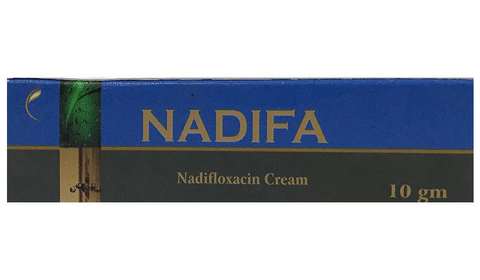
Nadifa Cream

Written By Dr. Anuj Saini, MMST, MBBS
Reviewed By Dr. Shilpa Garcha, MD (Pharmacology), MBBS
Last updated on 12 Nov 2024 | 01:01 AM (IST)
Nadifa Cream is an antibiotic that helps in the treatment of bacterial skin infections. It relieves the symptoms of the infection by stopping the further growth of the causative microorganisms.
Genuine
Authenticity Assured
802 people
viewed recently
₹107
₹110
3% off
Get for
₹96.3
right chevron icon
on orders above ₹150
Use Code 1MGANEW
Get for
₹98.4
right chevron icon
on orders above ₹200
Use Code 1MGANEW
1/2
10 gm Cream
 
 
0
footer-icon
efsr frrrrrr
aaa

General Information

The content is shown in English

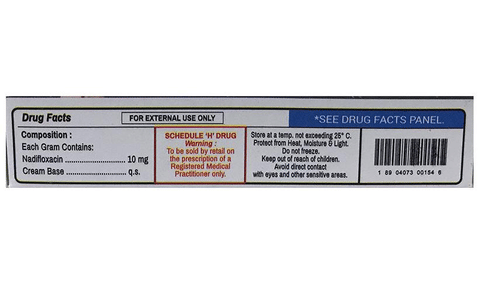
Nadifa Cream image
Nadifa Cream image

Product introduction

Nadifa Cream is for external use only. You should use it in the dose and duration as advised by your doctor. The affected area should be clean and dry before application of the ointment. You must wash your hands thoroughly before and after applying this medicine.

Some common side effects include burning sensation, irritation, itching, and redness at the site of application. Please consult your doctor if these side effects persist for a longer duration. Do not use it in the eyes, mouth, or nose as it may irritate. If accidental exposure occurs, rinse immediately with plenty of water.

Benefits of Nadifa Cream

Treatment of Bacterial skin infections
Nadifa Cream is an antibiotic that works by stopping the growth of infection-causing bacteria on your skin. It prevents the synthesis of essential proteins necessary for the survival of bacteria. It is effective against skin infections such as boils, impetigo, and infected hair follicles. It may also be used to treat infections in small cuts or wounds on your skin. This treatment has few common side effects and should clear up infections within a few days, but you should keep using it for as long as it is prescribed.

Side effects of Nadifa Cream

Most side effects do not require any medical attention and disappear as your body adjusts to the medicine. Consult your doctor if they persist or if you’re worried about them
Common side effects of Nadifa
  • Application site reactions (burning, irritation, itching and redness)

How to use Nadifa Cream

This medicine is for external use only. Use it in the dose and duration as advised by your doctor. Check the label for directions before use. Clean and dry the affected area and apply the cream. Wash your hands after applying, unless hands are the affected area.

How Nadifa Cream works

Nadifa Cream is an antibiotic. It kills the bacteria that cause skin infections by preventing the bacterial cells from dividing and repairing.

All substitutes for Nadifa Cream

For information purposes only. Consult a doctor before taking any medicine.

Quick tips

  • You have been prescribed Nadifa Cream for the treatment of bacterial skin infections.
  • It should be applied to the affected areas, two or three times daily, or as advised by your doctor.
  • Don't use it more often or for longer than advised by your doctor. Inform your doctor if your skin problem hasn't improved after seven days of treatment.
  • Treatment should be continued until at least two days after the condition has resolved.
  • Don't apply it to broken skin and take care to avoid getting it in your eyes, nose, or mouth.
  • Don't cover the area being treated with airtight dressings such as bandages unless directed by a doctor, as this may increase the risk of side effects.
  • It may cause temporary burning, itching, or redness at the application site. This is usually mild. Consult your doctor if you experience a more severe reaction.
  • You have been prescribed Nadifa Cream for the treatment of bacterial skin infections.
  • It should be applied to the affected areas, two or three times daily, or as advised by your doctor.
  • Don't use it more often or for longer than advised by your doctor. Inform your doctor if your skin problem hasn't improved after seven days of treatment.
  • Treatment should be continued until at least two days after the condition has resolved.
  • Don't apply it to broken skin and take care to avoid getting it in your eyes, nose, or mouth.
  • Don't cover the area being treated with airtight dressings such as bandages unless directed by a doctor, as this may increase the risk of side effects.
  • It may cause temporary burning, itching, or redness at the application site. This is usually mild. Consult your doctor if you experience a more severe reaction.

Safety advice

Alcohol

Alcohol

No interaction found/established

Pregnancy

Pregnancy

CONSULT YOUR DOCTOR
Nadifa Cream may be unsafe to use during pregnancy. Although there are limited studies in humans, animal studies have shown harmful effects on the developing baby. Your doctor will weigh the benefits and any potential risks before prescribing it to you. Please consult your doctor.
Breast feeding

Breast feeding

CONSULT YOUR DOCTOR
Nadifa Cream is probably unsafe to use during breastfeeding. Limited human data suggests that the drug may pass into the breastmilk and harm the baby.

Driving

Driving

No interaction found/established

Kidney

Kidney

No interaction found/established

Liver

Liver

No interaction found/established
sljrsr jrjrrrrr

Frequently asked questions

Before using Nadifa Cream, clean and dry the affected area. Gently and thoroughly massage it into the skin. Be careful not to get the medication in your eyes or mouth. If Nadifa Cream gets in your eyes accidentally, wash with plenty of water and call your doctor if your eyes are irritated.
Yes. Nadifa Cream is effective, safe and well-tolerated for acne. Use it as directed by the doctor to get the maximum benefit.
Be careful not to get Nadifa Cream into your eyes or mouth. If you happen to get it in your eyes, rinse off with plenty of water immediately and contact your doctor. You must not use Nadifa Cream if you are allergic to it or any of its ingredients. Tell your doctor if you notice any allergic reaction while using it for the first time. Inform your doctor if you are taking any medicines regularly, to prevent any allergic reaction with other medicines. Do not cover the area being treated with Nadifa Cream with a bandage, as this may increase absorption of this medicine and increase the side effects. Do not use more than what is recommended to relieve your symptoms faster. Using more than what is advised will only increase the side effects. Let your doctor know if you are planning to conceive. Pregnant and breastfeeding mothers should use Nadifa Cream only if prescribed by the doctor.
If you forget to use Nadifa Cream, do not worry and continue using Nadifa Cream as soon as you remember. However, if you are not sure and have any other doubts, please consult your doctor.
Nadifa Cream is safe if used in the dose and duration advised by your doctor. Use it exactly as directed and do not skip any dose. Follow your doctor's instructions carefully and let your doctor know if any of the side effects bother you.
No, do not stop using Nadifa Cream without consulting your doctor even if you are feeling better. Your symptoms may improve before the infection is completely cured. Therefore, for better and complete treatment, it is advised to continue your treatment for the prescribed duration.
Nadifa Cream is effective if used in the dose and duration advised by your doctor. Do not stop using it even if you see improvement in your condition. If you stop using Nadifa Cream too early, the symptoms may return or worsen.

Fact Box

Chemical Class

Fluoroquinolone

Habit Forming

No

Therapeutic Class

DERMA

Action Class

Quinolones/ Fluroquinolones

Related lab tests

test
100% genuine products
Safe & secure payments

No contact delivery

No contact delivery
Fully sanitized facilities


Patient concerns

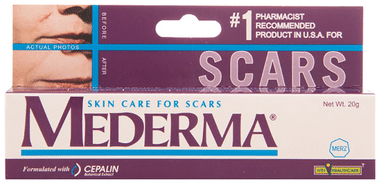
Scar on face due to bacterial infections

Dr. Atul Jain
Dr. Atul Jain
Dermatology
Pic is not clear, plz visit for proper opinion

I have a history of recurring yeast and bacterial vaginosis infections.

Dr. Sonu Balhara Ahlawat
Obstetrics and Gynaecology
Tab metrogyl 500 mg twice a day x 5 days and tab fluconazole 150 mg three doses alternate days
<h3 class=titleMediumExtraBold>Want to know more</h3>

Want to know more

We provide you with authentic, trustworthy and relevant information

<h3 class=titleMediumExtraBold>Have issue with the content</h3>

Have issue with the content

Disclaimer

Tata 1mg's sole intention is to ensure that its consumers get information that is expert-reviewed, accurate and trustworthy. However, the information contained herein should NOT be used as a substitute for the advice of a qualified physician. The information provided here is for informational purposes only. This may not cover everything about particular health conditions, lab tests, medicines, all possible side effects, drug interactions, warnings, alerts, etc. Please consult your doctor and discuss all your queries related to any disease or medicine. We intend to support, not replace, the doctor-patient relationship.

Marketer details

Name: Prism Life Sciences Ltd
Address: 10th floor, 'A' Wing, Great Eastern Summit, Sector - 15, CBD Belapur, Sector 15, CBD Belapur, Navi Mumbai, Maharashtra 400614

Vendor Details

Country of origin: India
A licensed vendor partner from your nearest location will deliver Nadifa Cream. Once the pharmacy accepts your order, the details of the pharmacy will be shared with you. Acceptance of your order is based on the validity of your doctor's ℞ and the availability of this medicine.

In case of any issues, contact us

Email ID: [email protected]
Phone Number: 0124-4166666
Address: 5th Floor Tower - B of the Presidency Building, 46/4 Mehrauli Gurgaon Road, Sector 14, Gurugram, Haryana-122001, India
close sheet