Sign in to your account
or
By signing in you agree to our
Terms & conditions
 and 
Privacy policy

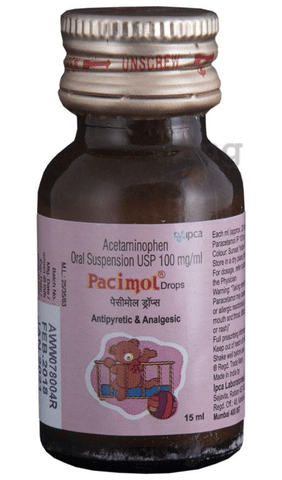
Pacimol Drops

Written By Dr. Shreya Gupta, MDS (Oral Pathology & Microbiology), BDS
Reviewed By Dr. Shilpa Garcha, MD (Pharmacology), MBBS
Last updated on 12 Nov 2024 | 01:05 AM (IST)
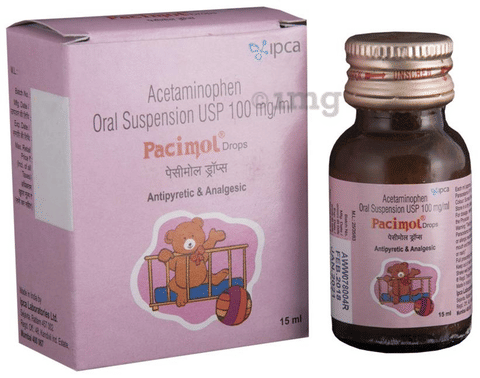
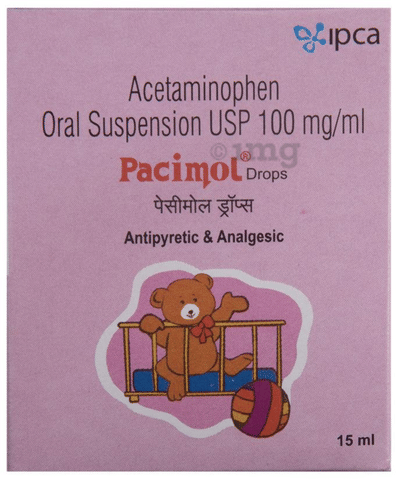
Pacimol Drops is a widely prescribed medicine that helps to ease pain and bring down high body temperature (fever). In children, it treats conditions like headache, toothache, body ache, fever, and common cold.
Genuine
Authenticity Assured
₹26.4 MRP ₹27.213% off 
Sku unavailable
 
 
0
footer-icon
efsr frrrrrr
aaa

General Information

The content is shown in English

Pacimol Drops image
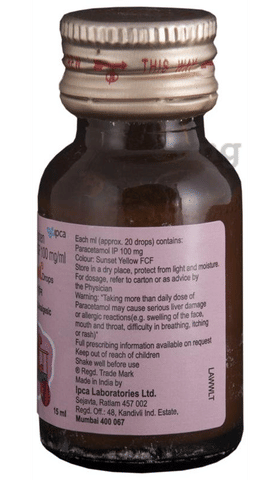
Pacimol Drops image
Pacimol Drops image
Pacimol Drops image
Pacimol Drops image

Your child’s medicine at a glance

Pacimol Drops is given orally preferably at a fixed time every day. Though this medicine can be taken before or after food, it is best given after food as it can irritate the inner lining of an empty stomach. The dose and duration will depend upon your child’s age, body weight, and severity of the infection, so stick to the dose, time, and way prescribed by your child’s doctor. If your child vomits within 30 minutes of taking the medicine, let the child calm down and repeat the same dose. Redosing is not recommended if your child vomits more than 30 minutes after taking a dose.

Do not give your child Pacimol Drops along with other medicines (many cold and flu medicines and other painkillers) that contain paracetamol, as this may result in overdosing and cause dangerous side effects such as hepatotoxicity (liver damage). Always check the ingredients of any other medicines before giving them to your child in combination with this medicine.

Generally, this medicine is well-tolerated by the children. However, temporary side effects such as indigestion, nausea, and vomiting may occur in some children. Consult your doctor in case these episodes become bothersome for your child.

This medicine is often considered safe and effective but may not be suitable for everybody. Inform your doctor if your child is undergoing treatment for any blood-related disorder, is allergic to any medicinal compound, or has any birth defects, liver impairment, or kidney dysfunction. This will help your child’s doctor evaluate the dose and suitability of this medicine in a better way.

Uses of Pacimol Drops in children

Benefits of Pacimol Drops for your child

Pain relief
Pacimol Drops is a common painkiller used to treat aches and pains. It works by blocking chemical messengers in the brain that tell us we have pain. It is effective in relieving pain caused by headache, migraine, nerve pain, toothache, sore throat, period (menstrual) pains, arthritis, and muscle aches. This medicine is very widely used and very rarely causes side effects if taken at the right dosage. Take it as it is prescribed to get the most benefit. Do not take more or for longer than needed as that can be dangerous. In general, you should take the lowest dose that works, for the shortest possible time. It is also the first choice of painkiller during pregnancy or breastfeeding.
Treatment of Fever
Pacimol Drops is also used to reduce a high temperature (fever). It works by blocking the release of certain chemical messengers that cause fever. It may be prescribed alone or in combination with another medicine. You should take it regularly as advised by your doctor.

Side effects of Pacimol Drops in children

Pacimol Drops does not pose serious side effects and is well-tolerated by children. In case the side effects do occur, they’re likely to subside once the body adapts to the medicine. Consult your child’s doctor if these side effects persist or bother your child. The most common side effects include-
Common side effects of Pacimol
  • Stomach pain
  • Indigestion
  • Nausea
  • Vomiting

How can I give Pacimol Drops to my child?

Take this medicine in the dose and duration as advised by your doctor. Check the label for directions before use. Measure it with a measuring cup and take it by mouth. Shake well before use. Pacimol Drops is to be taken with food.

How Pacimol Oral Suspension works

Pacimol Drops possesses analgesic (pain-reliever) and antipyretic (lowers body temperature) properties. It provides relief by blocking certain chemical messengers and pathways in the brain that send signals about pain and fever.

Quick tips

  • Give Pacimol Drops to your child with food or milk to prevent an upset stomach.
  • Your child should not take more than four doses of this medicine in 24 hours, so wait up to 6 hours between doses.
  • Never give any other medicine formulation containing paracetamol along with this medicine as that may lead to serious side effects.
  • Inform the doctor if your child has liver disease as the dose may need to be adjusted.
  • If Pacimol Drops does not seem to be helping your child, contact your doctor for advice. Do not give extra doses.

Safety advice

Kidney

Kidney

CAUTION
Pacimol Drops should be used with caution in patients with severe kidney disease. Dose adjustment of Pacimol Drops may be needed. Please consult your doctor.

Liver

Liver

CAUTION
Pacimol Drops should be used with caution in patients with liver disease. Dose adjustment of Pacimol Drops may be needed. Please consult your doctor.
However, the use of Pacimol Drops is not recommended in children with severe liver disease and active liver disease.
sljrsr jrjrrrrr

Frequently asked questions

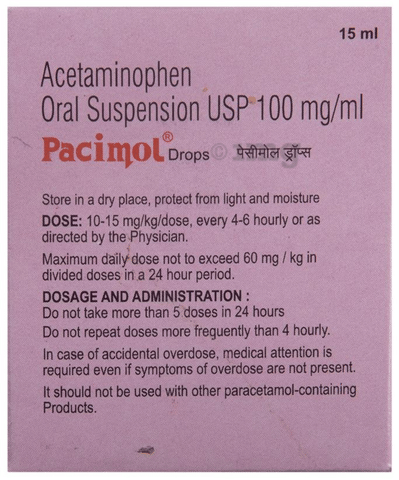
Always follow your doctor's instructions regarding how much of the medicine to give and how often to give it. This depends on the strength of the medicine and the age of your child. You may also check the label or the leaflet inside the packaging for directions before use. The commonly recommended dose is 10-15 mg/kg per dose every 4 to 6 hours. In case you are not sure how much to give, consult your child’s doctor.
Pacimol Drops usually starts working within 30 to 60 mins of intake and shows its peak effect within 3 to 4 hours. Your child may start to feel better after a few doses. In case the pain or fever persists longer, consult your child’s doctor immediately.
You can give this medicine if your child has a temperature of 38.3°C (101°F) or higher. But, you must always try to speak to your child’s doctor first.
If the fever doesn't come down after the initial few doses, the cause might be an infection (virus or bacteria). It is advised to consult your child’s doctor for specific treatment.
You should only take four doses of Pacimol Drops in 24 hours. There should be a gap of at least 4-6 hours between two doses. Do not take it for more than 3 days without first talking to your doctor. Based on the dose, more than 250 mg/kg can lead to toxicity and can be potentially fatal. An overdose is capable of causing serious damage to the liver and kidneys. Inform your doctor immediately if you think you have given too much of this medicine to your child, even if your child seems well, because of the risk of delayed, serious liver damage.
Unless instructed by your doctor, your child should take a normal balanced diet while continuing this medicine as lack of nutrition can put your child at risk of developing medicinal toxicity.
Keep this medicine at room temperature in a dry place beyond the reach of the children.
It is advised to use Pacimol Drops with caution if the child has malnutrition, G6PD deficiency, liver disease, or any medicinal allergy. So, do not hesitate to share your child’s complete medical history with the doctor as that will help the doctor decide whether the medicine is safe for your child or not.
It is always suggested not to give Pacimol Drops with vaccines that lead to fever. Rendering to the studies, doing so can reduce the efficacy of the vaccine.

Fact Box

Chemical Class

P-Aminophenol Derivative

Habit Forming

No

Therapeutic Class

PAIN ANALGESICS

Action Class

Analgesic & Antipyretic-PCM

Related lab tests

References

  1. Furst DE, Ulrich RW, Varkey-Altamirano C. Nonsteroidal Anti-Inflammatory Drugs, Disease Modifying Antirheumatic Drugs, Nonopioids Analgesics, & Drugs Used in Gout. In: Katzung BG, Masters SB, Trevor AJ, editors. Basic and Clinical Pharmacology. 11th ed. New Delhi, India: Tata McGraw Hill Education Private Limited; 2009. pp. 635-36.
  2. Grosser T, Smyth E, FitzGerald GA. Anti-Inflammatory, Antipyretic, and Analgesic Agents; Pharmacotherapy of Gout. In: Brunton LL, Chabner BA, Knollmann BC, editors. Goodman & Gilman’s: The Pharmacological Basis of Therapeutics. 12th ed. New York, New York: McGraw-Hill Medical; 2011. pp. 982-84.
  3. Grosser T, Smyth E, FitzGerald G. Pharmacotherapy of Inflammation, Fever, Pain, and Gout. In: Brunton LL, Hilal-Dandan R, Knollmann BC (Editors). Goodman & Gilman's: The Pharmacological Basis of Therapeutics. 13th ed. New York, New York: McGraw-Hill Medical; 2018.
  4. Children’s Health Queensland Hospital and Health Service. Emergency care of children: Medication guides for use in Queensland. [Accessed 26 Dec. 2020] (online) Available from:
  5. Royal College of Paediatrics and Child Health. Medicines for Children - information for parents and carers. [Accessed 26 Dec. 2020] (online) Available from:
  6. Paracetamol [EMC Patient Leaflet]. Leeds, UK: Rosemont Pharmaceuticals Limited; 2019. [Accessed 26 Dec. 2020] (online) Available from:
  7. Aabideen K, Moulton LS, Sills J. Accidental staggered paracetamol overdose: An interesting case report. J Pharmacol Pharmacother. 2011;2(3):189-190. [Accessed 26 Dec. 2020] (online) Available from:
  8. MedlinePlus. Acetaminophen. [Accessed 26 Dec. 2020] (online) Available from:
  9. Section on Clinical Pharmacology and Therapeutics; Committee on Drugs, Sullivan JE, Farrar HC. Fever and antipyretic use in children. Pediatrics. 2011;127(3):580-7. [Accessed 26 Dec. 2020] (online) Available from:

test
100% genuine products
Safe & secure payments

No contact delivery

No contact delivery
Fully sanitized facilities

User feedback

Once A Day
58%
Four Times A Day
19%
Thrice A Day
15%
Twice A Day
8%
Fever
80%
Headache
20%
Excellent
67%
Average
33%
Expensive
67%
Average
33%

Patient concerns

Suffering from body ache and stiffness due to chicken guniya/ Viral fever. How to get relief from pain.

Dr. Sunil Sekhri
Dr. Sunil Sekhri
Diabetology
Tab Pacimol 500 1 tab SOS and get yourself examined in clinic

Headach , fever and body pain fever is in low quantity.

Dr. Sunil Sekhri
Dr. Sunil Sekhri
Diabetology
Tab Pacimol 500 1 SOS

<h3 class=titleMediumExtraBold>Want to know more</h3>

Want to know more

We provide you with authentic, trustworthy and relevant information

<h3 class=titleMediumExtraBold>Have issue with the content</h3>

Have issue with the content

Disclaimer

Tata 1mg's sole intention is to ensure that its consumers get information that is expert-reviewed, accurate and trustworthy. However, the information contained herein should NOT be used as a substitute for the advice of a qualified physician. The information provided here is for informational purposes only. This may not cover everything about particular health conditions, lab tests, medicines, all possible side effects, drug interactions, warnings, alerts, etc. Please consult your doctor and discuss all your queries related to any disease or medicine. We intend to support, not replace, the doctor-patient relationship.

Marketer details

Name: Ipca Laboratories Ltd
Address: 142 AB, Kandivli Industrial Estate, Kandivli (West), Mumbai - 400 067, Maharashtra

Vendor Details

Country of origin: India
close sheet