






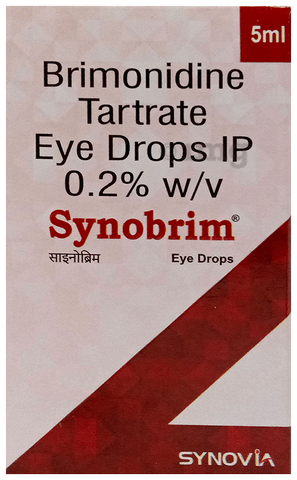
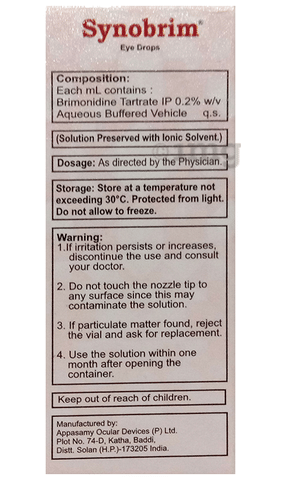

Synobrim Eye Drop
Brimonidine (0.2% w/v)
 Genuine
Authenticity Assured
 Prescription
required
Synobrim Eye Drop is used in the treatment of ocular hypertension (pressure in the eye) and glaucoma. It helps to lower high pressure in the eye and reduces the risk of vision loss. This medicine may be used alone or in combination with another eye drop that reduces pressure in the eye.
Written By Dr. Betina Chandolia, MDS, BDS,
Reviewed By Dr. Shilpa Garcha, MD (Pharmacology), MBBS,
Last updated on 12 Nov 2024 | 01:08 AM (IST)
Written By Dr. Betina Chandolia, MDS, BDS,
Reviewed By Dr. Shilpa Garcha, MD (Pharmacology), MBBS,
Last updated on 12 Nov 2024 | 01:08 AM (IST)
₹130
Get for
₹117

on orders above ₹150
Use Code 1MGANEW
Get for
₹120

on orders above ₹200
Use Code 1MGANEW
1/2
Welcome Gift | For First Order
10% EXTRA OFF
5 ml Ophthalmic Suspension



General Information

The content is shown in English



Safety advice

Alcohol
No interaction found/established

Pregnancy
CONSULT YOUR DOCTOR
Synobrim Eye Drop may be unsafe to use during pregnancy. Although there are limited studies in humans, animal studies have shown harmful effects on the developing baby. Your doctor will weigh the benefits and any potential risks before prescribing it to you. Please consult your doctor.

Breast feeding
CONSULT YOUR DOCTOR
Synobrim Eye Drop is probably unsafe to use during breastfeeding. Limited human data suggests that the drug may pass into the breastmilk and harm the baby.
To reduce the amount of Synobrim Eye Drop that reaches the breastmilk, place pressure over the corner of the eye for 1 minute or more, then remove the excess solution with an absorbent tissue.
To reduce the amount of Synobrim Eye Drop that reaches the breastmilk, place pressure over the corner of the eye for 1 minute or more, then remove the excess solution with an absorbent tissue.

Driving
UNSAFE
Synobrim Eye Drop may cause side effects which could affect your ability to drive.
Synobrim Eye Drop may cause blurred or abnormal vision. This effect may seem worse at night or in reduced lighting and this may affect the ability to drive.
Synobrim Eye Drop may cause blurred or abnormal vision. This effect may seem worse at night or in reduced lighting and this may affect the ability to drive.
Kidney
No interaction found/established

Liver
No interaction found/established
References
- Westfall TC, WestfallIn DP. Adrenergic Agonists and Antagonists. In: Brunton LL, Chabner BA, Knollmann BC, editors. Goodman & Gilman’s: The Pharmacological Basis of Therapeutics. 12th ed. New York, New York: McGraw-Hill Medical; 2011. p. 297.
- Biaggioni I, Robertson D. Adrenoreceptor Agonists & Sympathomimetic Drugs. In: Katzung BG, Masters SB, Trevor AJ, editors. Basic and Clinical Pharmacology. 11th ed. New Delhi, India: Tata McGraw Hill Education Private Limited; 2009. p. 144.
- Brimonidine tartrate. Fareham, Hampshire: FDC International Ltd.; 2010 [revised 24 Jun. 2014]. [Accessed 25 Jan. 2019] (online) Available from:

- Brimonidine. Irvine, California: Allergan, Inc.; 1996 [revised May 2010]. [Accessed 04 Apr. 2019] (online) Available from:
- Central Drugs Standard Control Organisation (CDSCO). [Accessed 04 Apr. 2019] (online) Available from:
- Brimonidine tartrate ophthalmic solution [Prescribing Information]. Irvine, CA: Allergan, Inc.; 2010. [Accessed 25 Jul. 2024] (online) Available from:
Related products
Products related to Synobrim Eye Drop





100% genuine products

Safe & secure payments

No contact delivery

Fully sanitized facilities

Want to know more
We provide you with authentic, trustworthy and relevant information
Have issue with the content
Why we need a prescription?
