






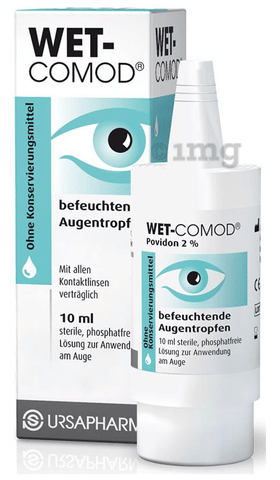
Wet-Comod Eye Drop
Written By Dr. Radhika Dua, MDS, BDS
Reviewed By Dr. Shilpa Garcha, MD (Pharmacology), MBBS
Last updated on 12 Nov 2024 | 01:02 AM (IST)
Wet-Comod Eye Drop is an antiseptic agent. It is used for cleaning the surface of the eye before an eye surgery or eye injection.
 Genuine
Authenticity Assured
₹377 MRP ₹3893% off



General Information

The content is shown in English


Safety advice

Alcohol
No interaction found/established

Pregnancy
CONSULT YOUR DOCTOR
Wet-Comod Eye Drop may be unsafe to use during pregnancy. Although there are limited studies in humans, animal studies have shown harmful effects on the developing baby. Your doctor will weigh the benefits and any potential risks before prescribing it to you. Please consult your doctor.

Breast feeding
SAFE IF PRESCRIBED
Wet-Comod Eye Drop is safe to use during breastfeeding. Human studies suggest that the drug does not pass into the breastmilk in a significant amount and is not harmful to the baby.

Driving
SAFE
Wet-Comod Eye Drop does not usually affect your ability to drive.

Kidney
No interaction found/established

Liver
No interaction found/established

References
- Briggs GG, Freeman RK, editors. A Reference Guide to Fetal and Neonatal Risk: Drugs in Pregnancy and Lactation. 10th ed. Philadelphia, PA: Wolters Kluwer Health; 2015. p. 1139.
- Povidone Iodine. Kingston-Upon-Thames Surrey: Bausch & Lomb U.K. Ltd.; 2012 [revised 26 Oct. 2017]. [Accessed 03 Apr. 2019] (online) Available from:

- Chaves RG, Lamounier JA. Breastfeeding and maternal medications. J Pediatr (Rio J). 2004;80(5 Suppl):S189-S198. [Accessed 29 Mar. 2019] (online) Available from:
- Central Drugs Standard Control Organisation (CDSCO). [Accessed 03 Apr. 2019] (online) Available from:


100% genuine products

Safe & secure payments

No contact delivery

Fully sanitized facilities
Patient concerns
I FEEL PAIN WHAIN I SIT ON COMOD?

Dr. Vipul Aggarwal
Orthopaedics
Kindly give relevant details
Throat infection and wet cough

Dr. Shubhra Chandhan Pradhan
ENT
It can be pharyngitis or chest infection. Need antibiotics and antihistamine with mucolytic. Consult an ENT specialist for proper clinical examination

Want to know more
We provide you with authentic, trustworthy and relevant information
Have issue with the content
