






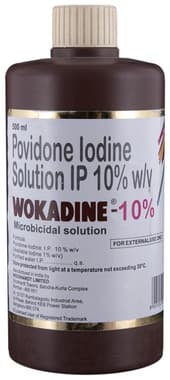
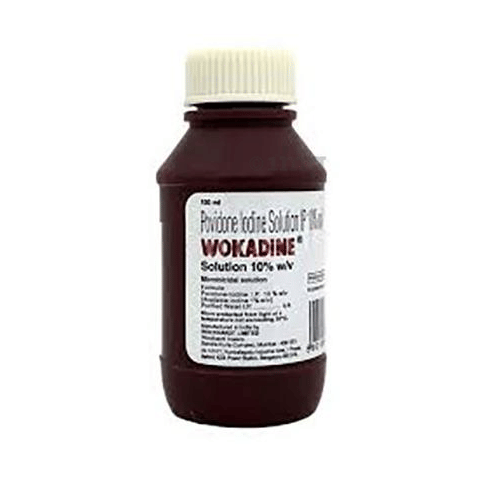
Wokadine 10% Solution
Written By Dr. Radhika Dua, MDS, BDS
Reviewed By Dr. Shilpa Garcha, MD (Pharmacology), MBBS
Last updated on 12 Nov 2024 | 01:10 AM (IST)
Wokadine 10% Solution is an antiseptic and disinfectant agent. It is used for the treatment and prevention of infections in wounds and cuts. It kills the harmful microbes and controls their growth, thereby preventing infections in the affected area.
 Genuine
Authenticity Assured
 Prescription
required
Size:
100 ml Solution

₹88.2 MRP ₹90.93% off
Available pack size

General Information
The content is shown in English


All substitutes for Wokadine 10% Solution
For information purposes only. Consult a doctor before taking any medicine.
Nicodin 10% Solution
by Abbott
₹96.32/solution
6% costlier

Betadine 10% Solution
by Win-Medicare Pvt Ltd
₹104.16/solution
15% costlier
Betadine 10% Solution
by Win-Medicare Pvt Ltd
₹520.8/solution
473% costlier
Drez 10% Solution
by Stedman Pharmaceuticals Pvt Ltd
₹52.05/solution
43% cheaper
Povidot 10% Solution
by Leeford Healthcare Ltd
₹69/solution
24% cheaper
Safety advice

Alcohol
No interaction found/established

Pregnancy
CONSULT YOUR DOCTOR
Wokadine 10% Solution may be unsafe to use during pregnancy. Although there are limited studies in humans, animal studies have shown harmful effects on the developing baby. Your doctor will weigh the benefits and any potential risks before prescribing it to you. Please consult your doctor.

Breast feeding
SAFE IF PRESCRIBED
Wokadine 10% Solution is safe to use during breastfeeding. Human studies suggest that the drug does not pass into the breastmilk in a significant amount and is not harmful to the baby.

Driving
No interaction found/established

Kidney
No interaction found/established

Liver
No interaction found/established

References
- Briggs GG, Freeman RK, editors. A Reference Guide to Fetal and Neonatal Risk: Drugs in Pregnancy and Lactation. 10th ed. Philadelphia, PA: Wolters Kluwer Health; 2015. p. 1139.
- Povidone Iodine. Watchmoor Park, Camberley Surrey: Novartis Consumer Health UK Ltd.; 1998 [revised 6 May 2014]. [Accessed 03 Apr. 2019] (online) Available from:

- Drugs.com. Povidone Iodine. [Accessed 06 Feb. 2019] (online) Available from:
- Chaves RG, Lamounier JA. Breastfeeding and maternal medications. J Pediatr (Rio J). 2004;80(5 Suppl):S189-S198. [Accessed 29 Mar. 2019] (online) Available from:
- Central Drugs Standard Control Organisation (CDSCO). [Accessed 03 Apr. 2019] (online) Available from:


100% genuine products

Safe & secure payments

No contact delivery

Fully sanitized facilities
Patient concerns
I had c section on 20 Feb 2017 and now since few days I see sticky discharge which usually use to be transparent previously is at times blood filled Why so? Shall I see my gyne for this?

Dr. Megha Gupta
Obstetrics and Gynaecology
Please visit your doctor for a check yp to rule out any infection of the wound site
skin infection,etchaing, and some part of body wound

Dr. Souvik Sardar
Dermatology
need a face to face consultation and clinical examination of the problem kindly visit a dermatologist nearby if you're from kolkata u can visit my chamber

Want to know more
We provide you with authentic, trustworthy and relevant information
Have issue with the content
Why we need a prescription?

Provide right medicines
Prescriptions are complex documents. We proof read and recheck at various steps to provide you the right medication in the correct form and dose

In accordance with the law
Most medicines cannot be sold without a valid prescription, as per the Drugs and Cosmetics Act, 1940 and Rules, 1945
